
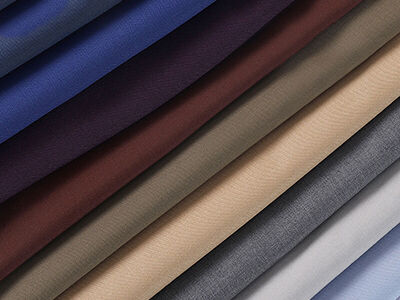
One of the most popular and strong weaves in the textile industry is twill. Twill is known to have a signature diagonal parallel ribs, good drape, wrinkle resistance and strength. You need to know about twill whether you are sourcing thobe, suiting, workwear or uniform fabric. With almost 20 years of manufacturing experience, more than 300 machinery sets and monthly production of 3 million meters of fabrics and 450 tons of yarn, we focus on the production of high-quality twill fabrics that are customized to suit the global markets.
Key Characteristics of Twill Fabrics
Twill is characterized by the weave pattern with each weft yarn crossing one or more warp yarns and then crossing two or more and making a staggered ladder-like structure. This design provides greater density and opaqueness to twill than to plain weave. Common twill angles include 45°, 60°, and 70°. To find twill, you need to find the diagonal lines that are seen through the surface of the fabric-most of them are on the right side. Twill fabrics are less likely to wrinkle and get stained too, thus they are suitable in heavy-use attire, such as medical and work wear.
Types of Twill and Their Applications
Twill is available in various forms with each being applicable to a specific end use:
Polyester/Cotton Blend Twill: Breathable and durable. It is good with uniform fabric and workwear, as it does not deteriorate during frequent washing and industrial washing.
100% Cotton Twill: Soft breathable used in shirt fabrics, pocket fabrics, and lightweight thobe fabric.
Polyester/Viscose Twill: Soft and luxurious, most suited when using in suiting fabric and linings. It is very drapeability and color retentive.
100% Polyester Twill: Strong and moisture-wicking, often used for scarf fabrics and outdoor workwear. It does not shrink and fade.
We have all these types in our product range such as polyester cotton yarn and polyester viscose yarn, so that we have complete control of our product, i.e. the fiber to the finished fabric.
Quality Standards for Twill Fabrics
When determining a good quality twill, one has to examine a number of parameters:
Diagonal consistency: The twill lines must be smooth and continuous.
Thread count: A higher thread count (e.g. 32x32 or 40x40) means an increased strength and smoothness.
Colorfastness: light and washing minimum Grade 4 (ISO standards).
Tensile and tear strength: The tensile and tear strength is particularly important in workwear and medical fabrics.
Shrinkage control: Less than 3 percent in cotton blends.
We have very high-level in house quality control at Hebei Ourui, beginning with checking of the yarns and right to the end testing of the fabric. We have our own R&D department to assist in the analysis of samples and to develop new products so that each batch is able to be sold to Ecuador, UAE, Saudi Arabia, Peru, Ethiopia and Tanzania since they have international standards.
Why Choose Hebei Ourui for Your Twill Fabric Needs
In our own plant, consistent quality, and reasonable prices, we offer end-to-end solutions to thobe fabric, suiting fabric, uniform fabric, 100% cotton scarf, and 100% polyester scarf. Monthly capacity of 450 tons of yarn and 3 million meters of fabric provide the quick lead times. We also provide bespoke R&D assistance on new products and accurate sample analysis support to support accurate quotations. Regardless of what kind of polyester/cotton blend or polyester viscose yarn you require, our team is determined to provide high quality customer service and quality assurance to all the markets we cover. Get in touch with us today to order samples or talk about your next twill fabric project.